
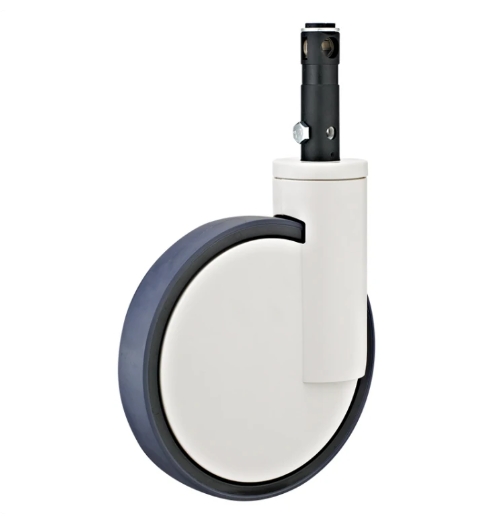
Central locking systems are becoming more common on medical equipment. These systems allow one pedal to control all casters at the same time. This makes it faster and easier for hospital staff to lock and unlock equipment.
A central locking system works through a mechanical linkage. When the user steps on the pedal, a rod or cable connects to all casters. The force is transferred to each caster, engaging the brake. When the user steps on the release pedal, the brakes are disengaged.
The main advantage of central locking is convenience. Hospital staff do not need to lock each caster individually. One foot movement locks all casters. This saves time and effort.
Central locking also improves safety. When all casters are locked together, the equipment is more stable. There is no risk of one caster being left unlocked by mistake.
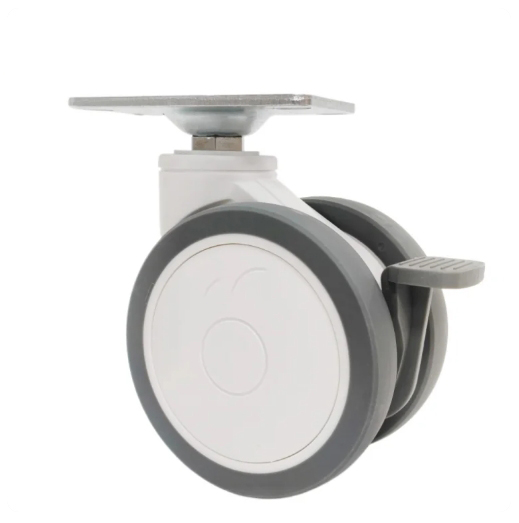
This is a medical caster
Our medical silent casters roll softly with low noise, won’t scratch ward floors. Sturdy load-bearing, easy to steer, safe and smooth for hospital beds, carts and medical equipment.
Central locking systems are common on hospital beds. Nurses need to lock and unlock beds many times each day. A central locking system makes this task much easier.
Central locking systems are also used on stretchers and patient transport equipment. These devices need to be locked quickly when transferring a patient. A central locking system allows one person to lock all casters while keeping both hands free.
Central locking systems require good design and quality parts. The linkage must be strong and reliable. It must work smoothly even after thousands of uses. The pedal must be easy to find and use.
Some central locking systems also include a directional lock feature. This allows the user to lock the casters to move only in a straight line. This is helpful when moving equipment down long hallways.
Central locking systems add cost to medical casters. But the benefits in convenience and safety often justify the extra expense.
FAQ
Are these medical casters quiet enough for hospital wards?
Yes. Soft rubber wheels greatly reduce rolling noise and will not wake resting patients.
Can the wheels scratch hospital floor tiles?
No. The elastic rubber surface slides gently and protects all kinds of medical flooring.
Do the casters support heavy hospital beds?
Absolutely. Each wheel has strong load capacity to hold full-size medical beds and supply carts.
Is 360-degree rotation available on these casters?
Sure. They rotate freely in all directions, easy for nurses to move gear in narrow aisles.
Does every caster come with a locking brake?
Can I clean the casters with hospital disinfectants?
Yes, they use medical-grade anti-corrosion material safe for regular sanitizing.
Are these wheels suitable for clinic and emergency rooms?
They work perfectly for hospital beds, medicine trolleys, treatment carts and stretchers.
Will the casters wear out quickly with daily heavy use?
The wear-resistant wheel structure offers long service life under frequent daily hospital use.
How do we manufacture casters
Step #1
Raw material preparation: metal (cold-rolled steel plate/manganese steel), wheel body materials (polyurethane/rubber/nylon, etc.), auxiliary materials (bearings, brake components, etc.) pre-treatment.
Step #2
Metal bracket processing: stamping and bending → welding/riveting → electrophoresis/galvanizing/chrome surface treatment.
Step #3
Wheel manufacturing: polyurethane/rubber wheels (mixing → injection molding → vulcanization/casting); Nylon/plastic wheels (automated injection molding); Cast iron/steel wheels (melting → casting → machining).
Step #4
Assembly of bearings and rotating systems: Install precision bearings to ensure flexible and low-noise rotation.
Step #5
Final assembly and functional integration: The wheel body is connected to the bracket, and modules such as brakes and shock absorbers are integrated.
Step #6
Quality inspection: Conduct tests such as load bearing, brake fatigue, salt spray, and visual/dimensional inspection.
Step #7
Packaging and Shipping: Classify packaging by model, support customized labels and logistics.
Leave Us A Message
Contact Info
Address
Room D01-6, Building 1, Mingwang E-commerce Factory Phase I, No. 96 Shunxing North Road, Henglan Town, Zhongshan City, Guangdong Province
Email Us
zam@youchiwujin.com
Call Us
8617727939956
8617727939956